Start with one memory chain
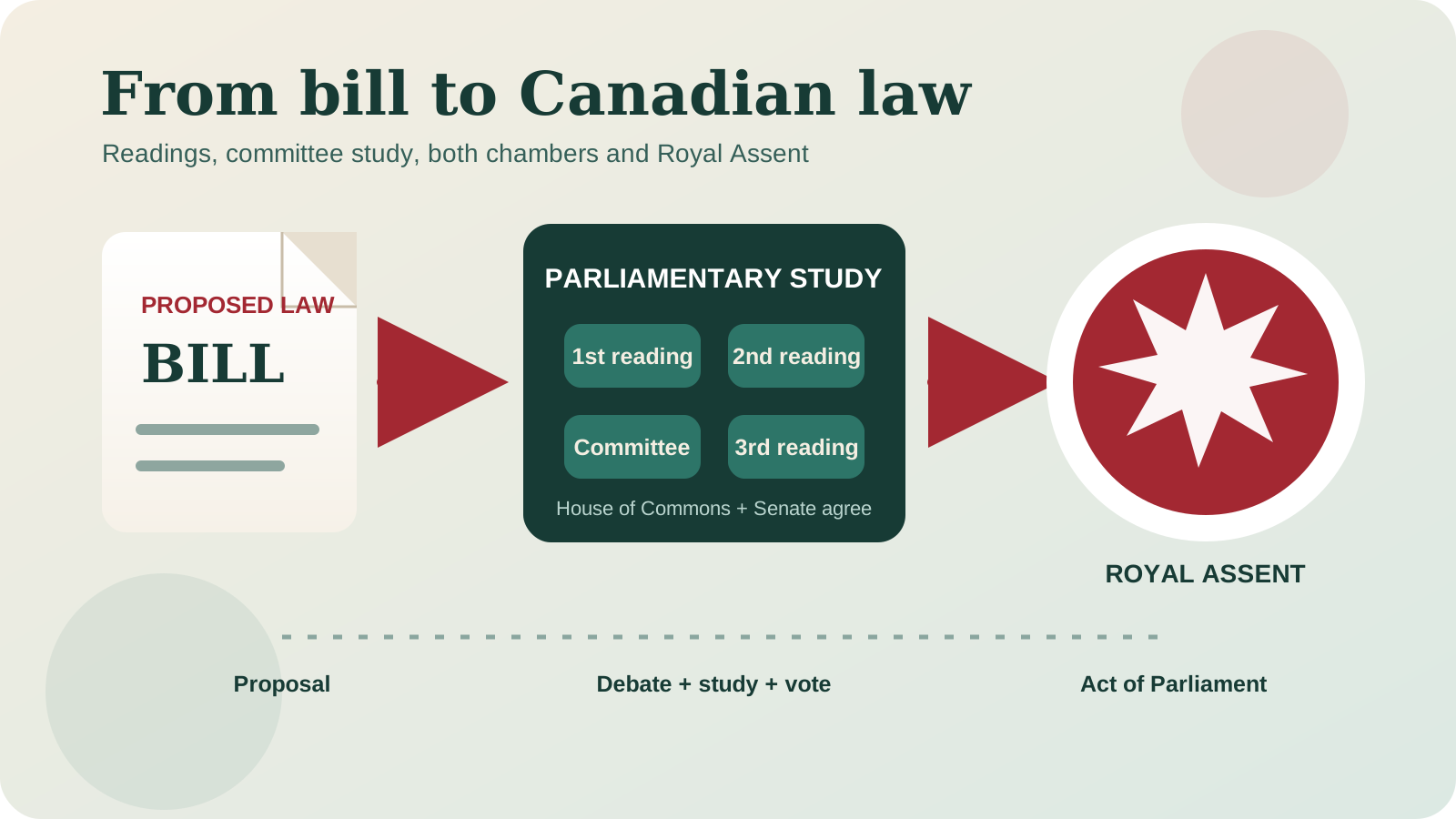
Use this sequence: bill, first reading, second reading, committee, report stage, third reading, other chamber, Royal Assent.
The sequence helps you separate the roles. The House of Commons and Senate debate, study, amend and vote. The Crown, represented federally by the Governor General, completes the parliamentary process through Royal Assent.
A bill is a proposed law
A bill is not yet an Act of Parliament. It is a proposal to create a law, change an existing law or repeal one.
Most public bills may begin in either the House of Commons or the Senate. Bills involving taxation or the spending of public money must begin in the House of Commons.
First reading introduces the bill
At first reading, the bill is formally introduced and made available. This stage puts the proposal before the chamber. The main debate about its principle comes later.
Memory hook: first reading means introduction, not detailed approval.
Second reading tests the main idea
At second reading, parliamentarians debate the principle and general purpose of the bill. A vote decides whether the bill should continue for detailed study.
If it passes, the bill is normally sent to a committee.
Committee study examines the details
A committee studies the bill closely. It may hear witnesses, examine evidence and review the bill clause by clause. Committee members can propose amendments.
This is the stage to connect with detailed study. The whole chamber debated the principle at second reading; the committee now examines how the text would work.
Report stage brings the bill back
The committee reports the bill back to the chamber. At report stage, parliamentarians consider the committee report and may propose further amendments under the chamber rules.
Report stage does not mean the bill is already law. It is still moving through Parliament.
Third reading is the final chamber debate
At third reading, debate focuses on the final form of the bill. The chamber then votes on passage.
Passing third reading in one chamber is not enough. The bill must also pass the other chamber.
The other chamber repeats the process
A bill passed by the House of Commons goes to the Senate, where it follows a similar sequence. A bill that begins in the Senate later goes to the House of Commons.
The Senate can propose amendments. The two chambers may exchange messages until both approve identical wording. If they do not agree on the same text, the bill cannot move to Royal Assent.
Royal Assent turns the bill into law
After both chambers pass the same text, the bill receives Royal Assent from the Governor General or a deputy. It then becomes an Act of Parliament and part of Canadian law.
Royal Assent and coming into force are related but not always the same date. An Act may take effect on Royal Assent, on a date written in the Act or on a later date set by an order of the Governor in Council.
Four common citizenship test confusions
- Three readings means three readings in each chamber, not three readings total for all of Parliament.
- Second reading focuses on the principle; committee study examines the details and can amend clauses.
- The Senate does not merely watch. It studies bills, votes and may propose amendments.
- Royal Assent makes a bill an Act, but some provisions come into force later.
Quick self check
- What is the difference between a bill and an Act?
- Which stage debates the main principle?
- Which stage studies clauses and hears witnesses?
- Why must the House of Commons and Senate agree on identical text?
- Who grants Royal Assent federally?
- Can an Act come into force after Royal Assent?